Armino Wi-Fi Instruction
Armino Wi-Fi Feature List
Compatible with 802.11 b/g/n/ax 2.4GHz Standard
Support both HT20 and HT40
Support 802.11N MCS0-7
Support STA、SoftAP and Direct Mode
Support AP+STA Concurrent
Support WPA、WPA2 and WPA3 Encryption
Support AMPDU、QoS
Suuport Low-Power in STA Mode
Armino Wi-Fi Programming Model
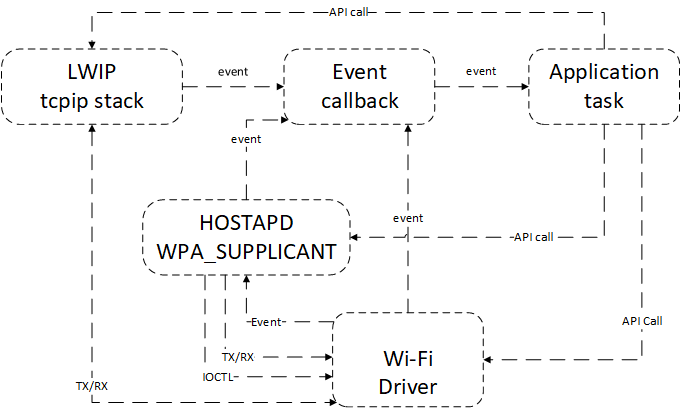
Wi-Fi Driver is an isolated component from upper-layer code(such as TCP/IP、Applicant Task..etc). Usually, Customer applicantion program is responsible for Wi-Fi initialization and necessary configuration. Wi-Fi Driver accepts and processes data requested by API, and nofitys the application to process related events.
Armino Wi-Fi Events
EVENT_WIFI_SCAN_DONE
The scanning completion event is reported when the full channels scan finshed. After receiving this event, the application’s event callback function could call bk_wifi_scan_get_result to get scan results.
EVENT_WIFI_STA_CONNECTED
The event indicates STA connecting with AP successfully. When received this event, Wi-Fi Driver will start DHCP server to get ip address or use static one according to the application’s response.
EVENT_WIFI_STA_DISCONNECTED
Wi-Fi_STA_DISCONNECTED event usually indicates the disconection from AP. The Client application needs to close sockets when receiving this event. If this event is not expected, it could start the reconnect process.
Armino Wi-Fi Station Connect Scenario
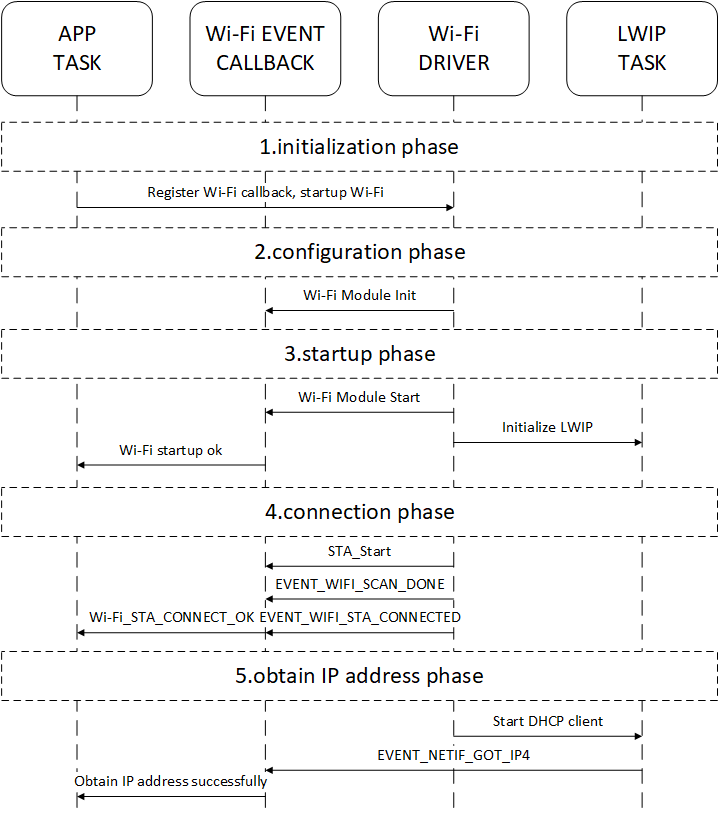
Wi-Fi Initialization
App Task calls app_wifi_init interface to initialize bk_event_init、bk_netif_init、bk_wifi_init
Wi-Fi Configuration
After Wi-Fi initialization, it will configure workqueue、Wi-Fi MAC、PHY…etc
Wi-Fi Starting Up
Wi-Fi Driver starts with interface
bk_wifi_sta_startCustomer could do some confgurations such as channel、modes、data rate..etc
Initialize Lwip stack and wpa_supplicant
Wi-Fi Connecting Phase
Wi-Fi Driver enters corresponding mode according to the latest config, default is STA mode
Excute scan and connect commands
Report EVENT_WIFI_SCAN_DONE based on the scanning results
After connecting successfully, Wi-Fi driver will return EVENT_WIFI_STA_CONNECTED
The callback function will transmit the connected event to application task
Wi-Fi Obtain IP
Start DHCP client to obtain IP address
SM_DHCP_DONE_IND will be sent after IP address was obtained
The application will creat TCP/UDP socket operation with this indication
Wi-Fi Station Connect Example
net sta enable
net sta scan once
net sta scan result
net sta config SSID PW              //keep PW NULL in OPEN Mode
net sta connect
Armino Wi-Fi Station Disconnect Example
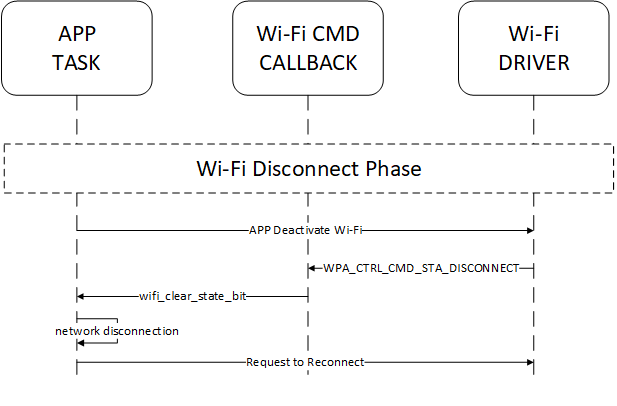
Application could call function
bk_wifi_sta_disconnectto deactivate from currently connected routerWhen Wi-Fi connection is disconnected due to active disconnection, offline router, or weak RSSI signal, the Wi-Fi event callback function will send
EVENT_WIFI_STA_DISCONNECTEDAfter receiving the network disconnection event, the application will clear all the network applications, for example, TCP/UDP client socket
Usually for unexpected Wi-Fi disconnection, the application will initialize a reconnection
Armino Wi-Fi shutdown Scenario
It is similar to Station disconnection case, please refer to previous chapter.
Armino Wi-Fi SoftAP Mode
The usage of BEKEN SoftAP mode could read bk_wifi_ap_start from API develop guide, stations list connected with AP comes from bk_wifi_ap_get_sta_list .
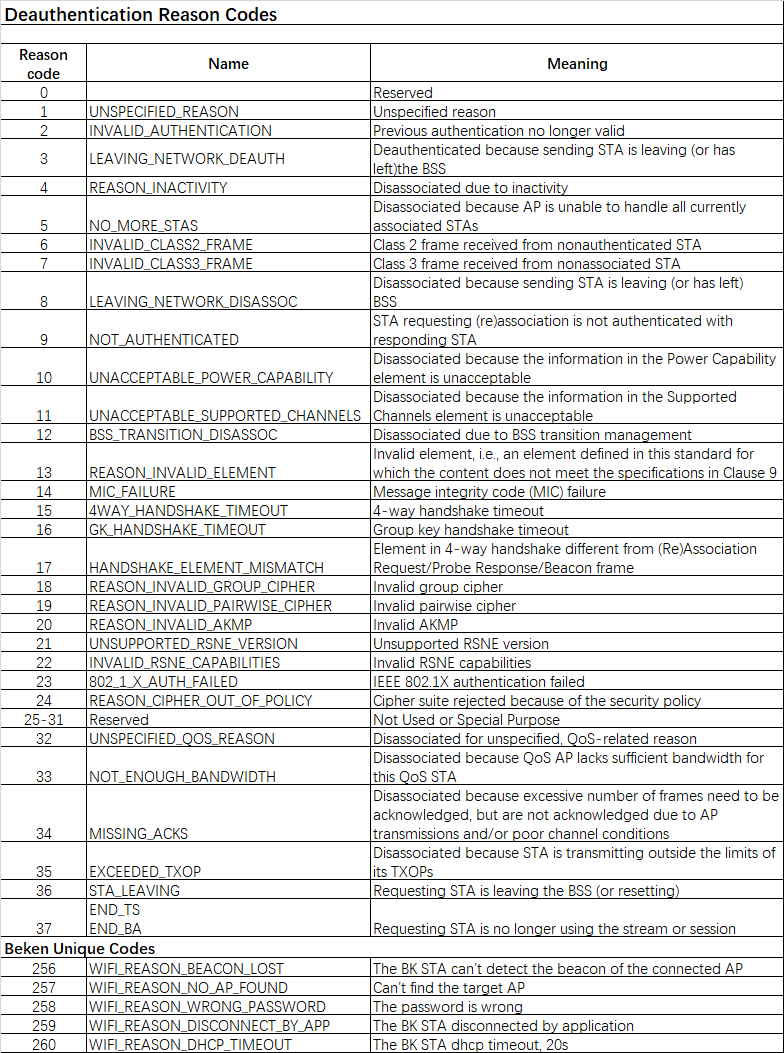
Armino Wi-Fi Failure Reason Code
Armino Wi-Fi MAC Address Configuration
The configuration of Wi-Fi MAC address is in bk_system\mac.c,it contains base_mac、sta_mac、ap_mac.The overall architecture of BEKEN Wi-Fi MAC address is as follows:
It contains three functional macros:CONFIG_NEW_MAC_POLICY、CONFIG_RANDOM_MAC_ADDR、CONFIG_BK_MAC_ADDR_CHECK,all of them are configured to yes by default
CONFIG_NEW_MAC_POLICY defines the MAC address are stored in the first 6 bytes of Net_param partition;if this area is empty,use a random MAC address
When first 6 bytes of Net_param are empty and CONFIG_RANDOM_MAC_ADDR is enabled,the MAC address is randomly generated then will be stored in Net_param partition.Certainly,the MAC address generated randomly will follow BEKEN MAC address rules: C8:47:8C
CONFIG_BK_MAC_ADDR_CHECK is used to determine whether the MAC address configured by the customer complies with the BEKEN rule C8:47:8C .If not required,set it to N in the defconfig file
All above three macro definitions are located in
middleware\soc\bk7236\bk7236.defconfig,with default values of yUsing the MAC Address Configuration Tool: bk_writer writes the MAC address to flash.If the flash is fully erased,it will cause the MAC address to be lost,resulting in the use of random MAC address
use command
macfor temporary test,the example is as follows:
mac c8478caabbcc
Armino Wi-Fi Fragmentation
Wi-Fi receive fragmentation is supported, but Wi-Fi transmit fragmentation is not supported.
Armino Wi-Fi Buffer Usage
Introduction to Wi-Fi buffer memory and LwIP buffer memory
Wi-Fi memory block usage: mainly hardware receive buffer, software transmit descriptor. The hardware receive buffer is designed for the hardware side of the chip, with a default configuration size that cannot be changed by the software side. The memory used for software transmit descriptor and SKB memory block are requested from SRAM in “dynamic” way.
LWIP Memory Block Management: LwIP memory is allocated by the software side, and a certain size of MEM is “dynamically” taken out from the SRAM HEAP for LwIP use by means of macro definition.
Importance of LwIP/Wi-Fi Buffer Memory Configuration
In order to achieve a robust, high-performance system, we need to consider memory usage or configuration very carefully because:
Given the limited overall memory on Armino, the Wi-Fi and LWIP sides cannot request unlimited memory for normal system operation.
In order to get better and better performance from Wi-Fi, the default TRX memory usage in the LwIP driver is dynamically configured proportionally to achieve the highest Mem utilization to alleviate the problem of tight Mem usage during TX or RX.
Wi-Fi throughput depends heavily on memory-related configurations such as TCP window size, number of LwIP Wi-Fi receive/transmit data buffers, etc. The Wi-Fi throughput is also dependent on the number of memory buffers available in the LwIP.
The peak total memory that may be used in Armino LwIP depends on factors such as scenario requirements, e.g., extreme throughput acquisition, maximum TCP/UDP connections that the application may have, relaying, and other scenarios.
The total memory required by the application is also an important factor when considering memory configuration.
For these reasons, there is no one parameter configuration that fits all applications. Instead, we must take into account that different memory configurations are considered for each different application.
Armino Data Flow and Memory Usage Patterns
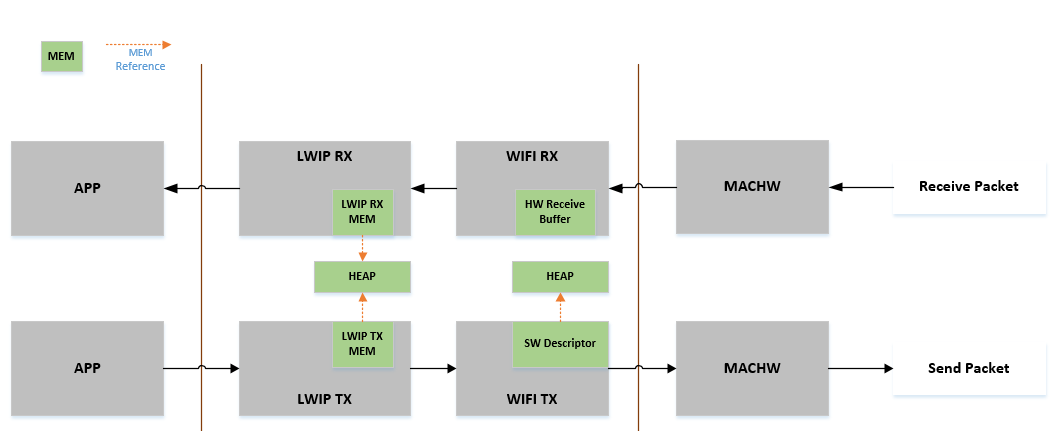
Armino wifi data flow
The Armino data flow path is roughly divided into three layers, namely, the application layer, the WIFI layer and the hardware layer, of which the WIFI layer includes the LWIP layer and the MAC layer as well as the related interface layer.
RX Direction: During the data receiving process, the hardware transfers the received packets to the receive data buffer of Wi-Fi, the receive data buffer of LWIP for relevant protocol processing, and finally uploads them to the application layer. the receive data buffer of Wi-Fi and the receive data buffer of LWIP share the same buffer by default. the receive data buffer of Wi-Fi and the receive data buffer of LWIP share the same buffer by default. the receive data buffer of Wi-Fi and the receive data buffer of LWIP share the same buffer by default. Both Wi-Fi receive data buffer and LWIP receive data buffer size are requested from SRAM HEAP. the LWIP receive data buffer size (LWIP_MEM_SIZE) can be configured according to the requirements of different scenarios.
TX Direction: During the data sending process, the application first copies the message to be sent to the MEM (dynamically requested memory) of LWIP through the LWIP data interface for TCP/IP encapsulation, and then sends the message to the send data buffer of Wi-Fi layer for MAC encapsulation processing, and finally waits for sending. In order to save SRAM HEAP space, Armino uses PSRAM space for the data transfer copy in the upper layer application, while relieving the pressure on SRAM memory without reducing the available memory for the application.
How to Improve Armino Wi-Fi Performance
The performance of Armino Wi-Fi is affected by a number of parameters that are related and constrained by each configuration parameter. If the configuration parameters are reasonable and optimal, it will not only improve the performance, but also increase the available memory for the application and improve the stability.
In this section, we will briefly introduce the operating modes of the Wi-Fi/LWIP stack and explain the role of each parameter. We will recommend the corresponding parameter configurations so that you can choose the most appropriate configuration according to your usage scenario.The Wi-Fi performance can be improved by adjusting the size or number of MEMs in each of the above layers. Below we will introduce the parameters you need to configure.
Receive Data and Transmit Data Direction (TRX) highly relevant parameters
CONFIG_LWIP_MEM_SIZE
This parameter indicates the LWIP layer heap memory size, which is requested from the system heap memory. The default configuration size for this parameter is 51200 (50K). If a large amount of data needs to be sent or received, increasing this parameter can improve the overall throughput performance.
CONFIG_LWIP_TCP_MSS
This parameter represents the TCP maximum message length, which is an option defined by the TCP protocol. The MSS (Maximum Segment Size) option is used to negotiate the maximum length of data that can be carried by each message segment when a TCP connection is established and both the sender and receiver are communicating. This parameter can be set lower to save RAM and defaults to 1460 (ipv4)/1440 (ipv6) for optimal throughput. IPv4 TCP_MSS range: 576 <= TCP_mSS <= 1460 IPv6 TCP_MSS range: 1220 <= TCP_mSS <= 1440
CONFIG_LWIP_MEMP_NUM_NETBUF
This parameter indicates the number of NetBuf structures. Setting this value too small when programming with netconn and socket may result in a failure to allocate memory when receiving data, thus not serving data sending and receiving for several connections at the same time. The minimum configuration on Armino is 16 and the maximum is 32. Here it is recommended to configure the maximum of 32 by default.
CONFIG_LWIP_PBUF_POOL_SIZE
This parameter indicates the number of buffers in the pbuf pool, the parameter is configurable. Maximum configuration is 20, on Armino it is recommended that the default configuration size is 10.
CONFIG_LWIP_TCP_SND_QUEUELEN
This parameter indicates the TCP send buffer space, this parameter limits the number of pbufs in the send buffer. This parameter is set to 40 by default and must be at least equal to (2 * TCP_SND_BUF/TCP_MSS) to work properly.
CONFIG_LWIP_MEMP_NUM_TCP_SEG
This parameter indicates the number of segments of TCP that can be in the queue at the same time, the default parameter sets the size to 80 and must be equal to at least (2 * LWIP_TCP_SND_QUEUELEN) to work properly.